On January 30, 2026, $XNV was listed on the NonKyc exchange. For a lot of projects, a listing is the goal. For Nerva, it was just a checkpoint. Since then, XNV has been added to two more exchanges, CEXSwap and NoirTrade, giving people more ways to trade it. And in the months since, the community has shipped an enormous amount of work, which we wanted to look back on and share.
First, a quick note for anyone new here. Nerva (XNV) is a private, community-run cryptocurrency. It’s mined with ordinary computer processors (CPUs), the kind already in your laptop or desktop, with no mining pools and no expensive specialized hardware. The whole idea is fairness: one person, one CPU, a real vote in the network. There’s no company behind Nerva and no paid team. Everything below happened because people in the community chose to build it.
The core software: four releases and a major upgrade
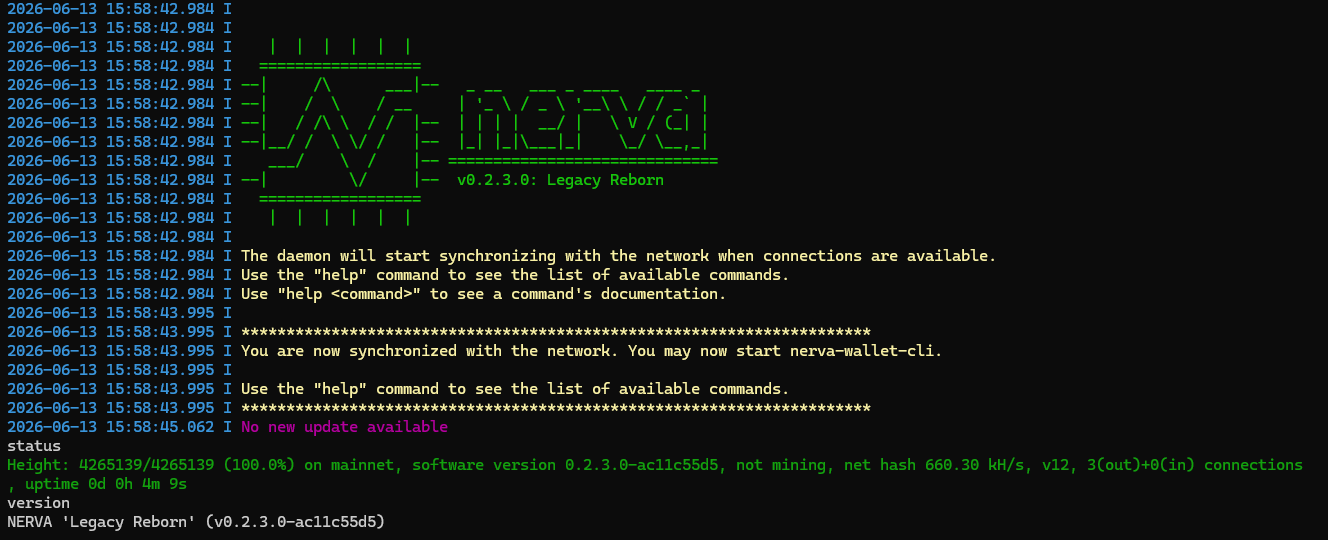
The “core” is the daemon, the program that runs the Nerva network and validates every transaction. In under six months it saw four public releases, building toward the biggest upgrade in years:
- v0.2.1.0 through v0.2.3.0 (April to June): a steady run of improvements, better support for more devices, faster and more reliable syncing, modernized networking, and a long list of bug fixes and safety fixes.
- v0.3.0.0 “Legacy Remade” (July): this was Hard Fork 13, a network-wide upgrade. It introduced a redesigned mining algorithm (CryptoNight-Adaptive v6) that’s even more resistant to the specialized machines and GPU farms that centralize other coins, keeping mining fair for everyday CPUs. It also made syncing a new node dramatically faster.
If some of that sounds technical, the short version is simple: Nerva got faster, safer, runs on more devices, and its mining stays fair.
Hard Fork 14: what’s coming next
The next network upgrade, Hard Fork 14, is already in development, and it’s a big one for privacy. Here’s what it brings, in plain terms:
- Stronger privacy per transaction. A larger anonymity set means each payment you send is hidden among more possible decoys, making it even harder for anyone to trace.
- Smaller, more efficient transactions. Newer cryptographic signatures (CLSAG) and proofs (Bulletproofs+) do the same job as before while taking up less space, which means lower fees and a leaner blockchain.
- Even fairer mining. A further-evolved mining algorithm (CryptoNight-Adaptive v7) continues to level the playing field so ordinary CPUs stay competitive and the network stays decentralized.
In short: more private, more efficient, and still fair to mine on any computer.
NervaOne: a wallet and miner that grew up fast
NervaOne is the all-in-one app that makes Nerva approachable: wallet, node, and mining in one place. It also supports several other coins, so it’s a single home for a good chunk of your crypto. This was one of the busiest projects of the last six months, with five releases that transformed what it can do.
- v0.8.5.0 (March): remote nodes. Added the ability to connect to a remote node for wallet-only use.
- v1.0.0 (April), a major milestone: NervaOne went mobile. Alongside the desktop app, it launched on Android, with a redesigned interface that works on phone and computer alike. It also added a one-tap option to download the blockchain for much faster setup, and made connecting to a public node far simpler. You can run it as a full node or in lightweight wallet-only mode, whatever suits you.
- v1.1.0 (May): Bitcoin support. NervaOne added BTC, with full or pruned node options, wallet creation and restore, and a fee preview before you send.
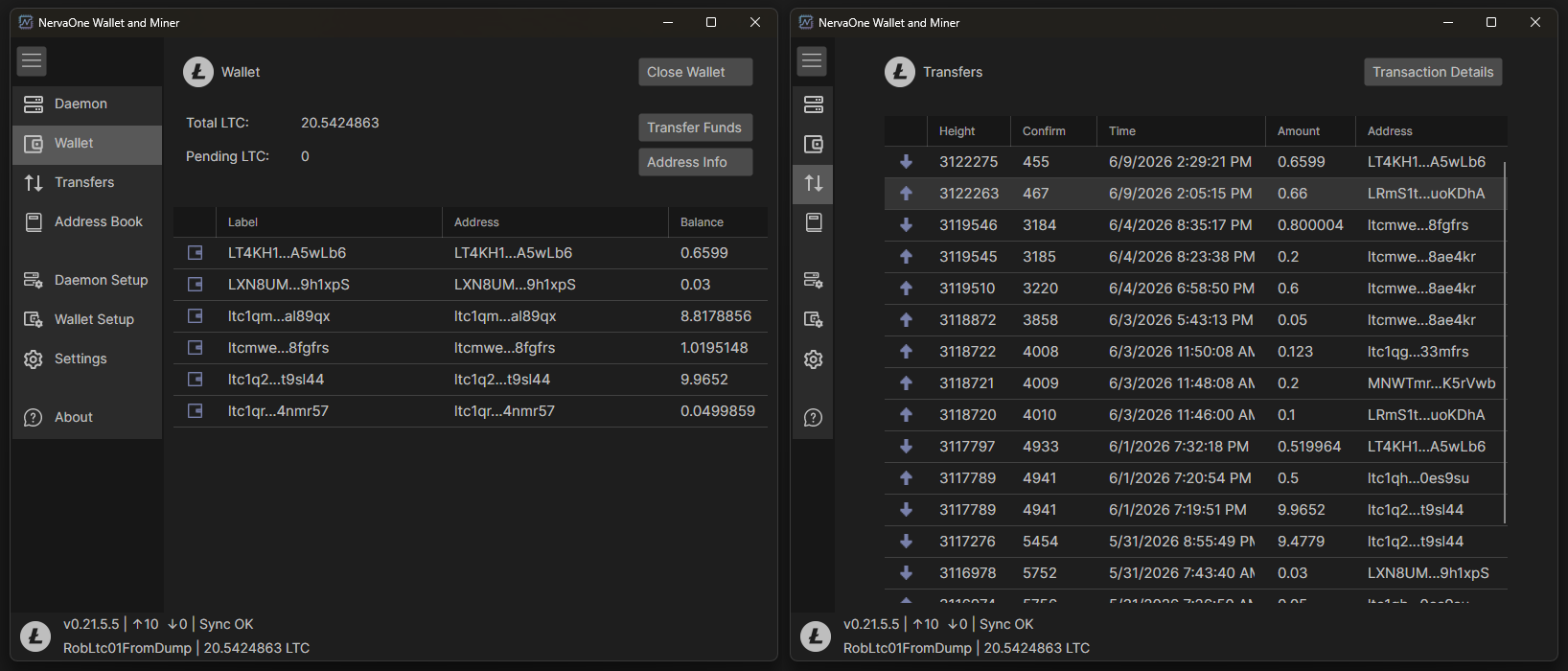
- v1.2.0 (June): Litecoin support. Next came LTC (including MWEB), plus stronger security under the hood, encrypted RPC authentication and sensitive credentials scrubbed from log files.
- v1.3.0 (July): mining and security polish. A Nerva mining affinity toggle to keep your hashrate steady while you use your PC, cryptographically secure wallet credentials, and precision fixes for rock-solid balances.
That’s a lot in half a year: a mobile launch, two major new coins (BTC and LTC) on top of the Nerva, Monero, Wownero, and Dash it already supported, and a steady march of security and usability upgrades. If you’re new and want the simplest starting point, NervaOne is it.
Nerva Quest: get involved and earn XNV
One of the most fun ways to join in launched in this window: Nerva Quest, a community rewards platform. The tagline says it best: Create. Engage. Earn XNV.
You complete simple quests that help the Nerva ecosystem, Daily Quests and bigger Epic Quests, submit your proof, and claim real XNV as a reward. No email, no KYC, no barriers. It’s the easiest way for a newcomer to earn their first Nerva just by participating.
And the community has run with it: over 600 XNV has already been paid out, across hundreds of completed quests. That’s real rewards going to real people for helping the project grow.
Growing beyond Nerva: new tools and integrations
Nerva also showed up in more places built by the wider crypto community, a sign the ecosystem is reaching outward:
- BoxWallet by richardltc, a terminal-based wallet manager that installs, starts, and monitors coin daemons from a single simple interface, with Nerva now among the supported coins.
- coinQuests by richardltc, a quest platform where you complete simple social tasks for the coins you follow, Nerva included, and earn payouts.
You can find these and more on the community projects page.
The website and docs: kept current and clear
The public face of the project stayed in step with everything shipping:
- nerva.one got a visual refresh, including a new dark mode, a roadmap showing exactly what’s done and what’s coming, live upgrade countdowns, and download links kept current with every release.
- docs.nerva.one was rewritten to be accurate and easier to follow, updated guides, current specs, and a clearer explanation of what makes Nerva’s fair, pool-free mining actually work.
Still just getting started
Six months. Four releases. A major network upgrade with another already in development. A maturing wallet. A rewards platform paying out real XNV. New integrations from the wider community. A refreshed website and docs. All of it built by a community, for a community, with no company pulling the strings.
And it doesn’t stop here. Hard Fork 14 is on the way, along with other initiatives the community is actively building. Nothing is handed down from above, what gets built next depends on the people who show up.
If any of this speaks to you, there’s room to help shape it. Come mine, come build, come earn, come say hello on Discord or Telegram.
1 CPU = 1 Vote.