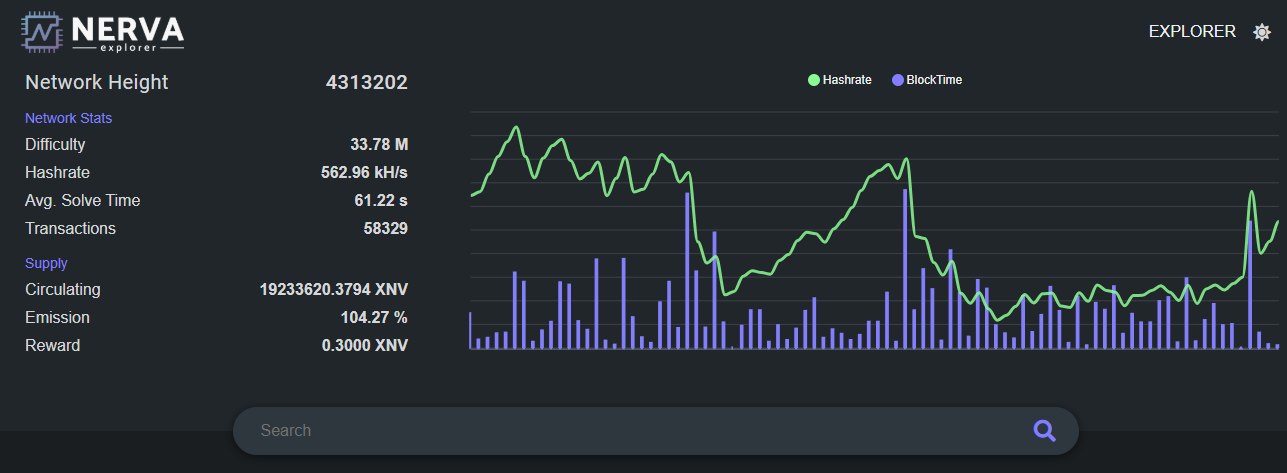
If you’re watching Nerva’s network hashrate around Hard Fork 13, brace yourself for a big drop. Right after the fork, net hashrate is going to fall sharply, we expect around a 90% drop, from 400 – 800 kH/s in the last few months to somewhere around 50 kH/s afterwards.
Before anyone panics: this is expected, it’s healthy, and it does not mean the network got weaker. Here’s exactly what’s happening and why.
The short version
Hashrate measures how many hashes the network computes per second. Hard Fork 13 replaces the mining algorithm with CryptoNight-Adaptive v6, and each hash on the new algorithm does far more work than a hash on the old one. So the same computers, working just as hard, produce far fewer hashes per second.
The number goes down because the unit changed, not because the network lost security or miners.
Why each hash is now so much heavier
Three things make a CNA v6 hash much more expensive to compute than the old algorithm:
- A 4x larger scratchpad. The old algorithm used a 2 MB memory buffer per hash. CNA v6 uses 8 MB. Every single hash now has to work through four times as much memory.
- A random program per block. Instead of one fixed calculation, each block runs a freshly generated program of hundreds of instructions, executed thousands of times. That’s a lot more computation packed into every hash.
- Dependent memory access. The algorithm is built so each memory step depends on the result of the one before it. Your CPU can’t run ahead or do the work in parallel, it has to wait for each step, which deliberately slows each hash down.
Add those together and a single hash takes far longer than it used to. If each hash takes roughly ten times as long, the hashes-per-second number falls by about ninety percent. Same hardware, same effort, much heavier hash.
Comparing the two numbers is apples to oranges
This is the key thing to understand: you cannot compare hashrate across two different algorithms. It’s like comparing miles per hour to laps per hour. A lower number on a longer track doesn’t mean you slowed down.
500 kH/s on the old algorithm and roughly 50 kH/s on the new one represent a similar amount of real work being done by a similar set of machines. The headline number shrank because each hash now counts for a lot more.
What about network security?
A smaller hashrate number does not make Nerva easier to attack. Security comes from how expensive it is to out-compute honest miners on the same algorithm, and CNA v6 is more expensive and more resistant to specialized hardware than the old algorithm, not less.
In fact, the new algorithm strengthens security in ways the raw number doesn’t show. The large memory requirement and random program are specifically designed to shut out ASICs, FPGAs, and GPUs, keeping mining on general-purpose CPUs where it stays widely distributed. An attacker can’t just buy specialized machines to overpower the network. They’d have to out-CPU everyone else, on an algorithm built to keep any single machine from running away with it.
What miners will notice
Your personal hashrate number will drop too, and that’s completely normal. What matters is your share of the network, and everyone’s numbers drop together, so your slice, and your rewards, stay proportional.
A few other things to expect:
- Block times stay normal. Difficulty automatically readjusts to the lower hashrate, so blocks keep coming at about 60 seconds.
- Un-upgraded miners fall off the real chain until they update to v0.3.0.0.
Bottom line
When you see Nerva’s hashrate drop around 90% at Hard Fork 13, that’s the algorithm change doing exactly what it’s supposed to. The number is smaller because each hash is much bigger. The network is just as secure, more resistant to specialized hardware, and still mined by everyday CPUs the way Nerva is meant to be.
Nerva has always stood for one CPU, one vote. With HF13, reality just moved a lot closer to that vision.
If you haven’t upgraded yet, do it before the fork at block 4,320,000 so you don’t miss a beat: https://nerva.one/#downloads