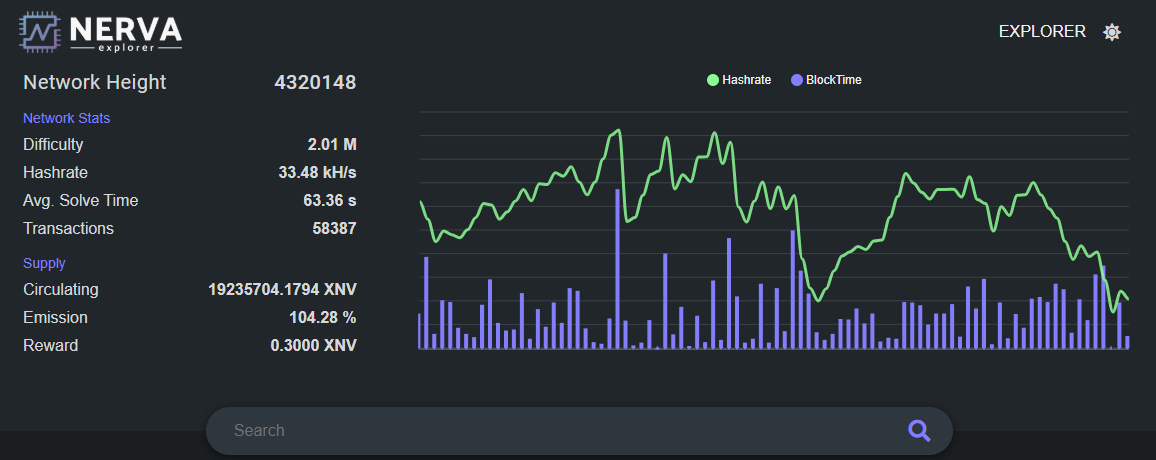
Nerva forked at block 4,320,000 on July 21, 2026, and the network is now running on CryptoNight-Adaptive v6. It went smoothly, and the numbers have already settled.
This was our first hard fork in over six years. The last one was February 6, 2020, at block 930,000. Six years and five months is a long time between forks, and getting a network this old through a Proof of Work change without drama is not a given. It happened because people prepared.
What the numbers look like now
If you glance at the explorer and panic, don’t. Here’s the before and after:
- Hashrate: ~400 – 800 kH/s before the fork, now stabilized between 25 and 40 kH/s
- Difficulty: 30M+ before, now around 2M+
- Block time: back to roughly 60 seconds, right on target
That’s over a 90% drop in the reported hashrate, which is almost exactly what we predicted before the fork. The number is smaller because each hash on the new algorithm does far more work. CNA v6 uses an 8 MB scratchpad, generates a fresh random program every block, and forces each memory access to depend on the previous one. Same hardware, same effort, far fewer hashes per second.
Comparing hashrate across two different algorithms is apples to oranges. A lower number here does not mean fewer miners or less security. We wrote a full explanation of this before the fork, and it holds up: Hashrate After Hard Fork 13: Why the Number Will Drop, and Why That’s Fine
Why it went smoothly
Hard forks go badly when nobody’s ready. This one had a two week runway, and the ecosystem used it.
Every centralized service integrated with Nerva upgraded to v0.3.0.0 before the fork: the exchanges (NonKyc, CexSwap, NoirTrade), the explorer and API, TipBot, NerVault, NervaQuest, and coinQuests. That meant no service downtime and nothing for their users to do.
Node adoption climbed steadily too, from 19% in the first two days after release to 69% by fork day. Most miners and node operators paid attention, and it showed.
What Hard Fork 13 actually changed
CryptoNight-Adaptive v6. The new Proof of Work keeps mining on ordinary CPUs and pushes back hard against ASICs, FPGAs, and GPUs. The larger scratchpad moves the working set out of CPU cache and into main memory, and the dependent access pattern stops fast chips from hiding memory latency. The practical result is that a high end machine can’t run away with the network the way it can elsewhere, and modest hardware stays competitive.
Privacy and consensus hardening. Transaction validation is stricter now, including a minimum output rule and tighter requirements on the outputs referenced by ring signatures.
Missed the upgrade?
If your node ran through the fork on an old version, it’s on the wrong chain, but it’s fixable.
- Upgrade to v0.3.0.0: https://nerva.one/#downloads
- Pop blocks back below the fork height with
nervad --pop-blocks X, where X is your current height minus 4,320,000, plus about 10 for safety. In NervaOne, use Daemon Setup > Restart with Optional Command and enter--pop-blocks X.
Your node will resync onto the correct chain from there. Popping a few extra blocks does no harm.
What’s next
Work on Hard Fork 14 has already started. The plan includes CLSAG and Bulletproofs+ (smaller, faster transactions with the same privacy), a ring size increase for a larger anonymity set, and potentially CryptoNight-Adaptive v7 to even out per-core hashrate further across different CPUs. No fork heights are set, and nothing changes until they are.
The direction is the same as it’s always been: close the privacy gap with Monero while keeping what makes Nerva different, solo CPU mining with no pools and no central authority. 1 CPU = 1 Vote.
Thank you
This went well because the community made it go well. People developed, tested, reported issues, upgraded their nodes, and nudged the stragglers. Contributors wrote the code, reviewed it, and shipped it.
Nerva has always stood for one CPU, one vote. With HF13 live, reality moved a lot closer to that vision.