Nerva sync speed testing

Nerva Sync Speed: A Big Step Forward

One of the most common complaints from new Nerva users is how long it takes to sync the blockchain from scratch. We heard you. We’ve been working on a set of code optimizations (tracked internally as PR65) specifically targeting sync performance, and we now have real benchmark results to share.

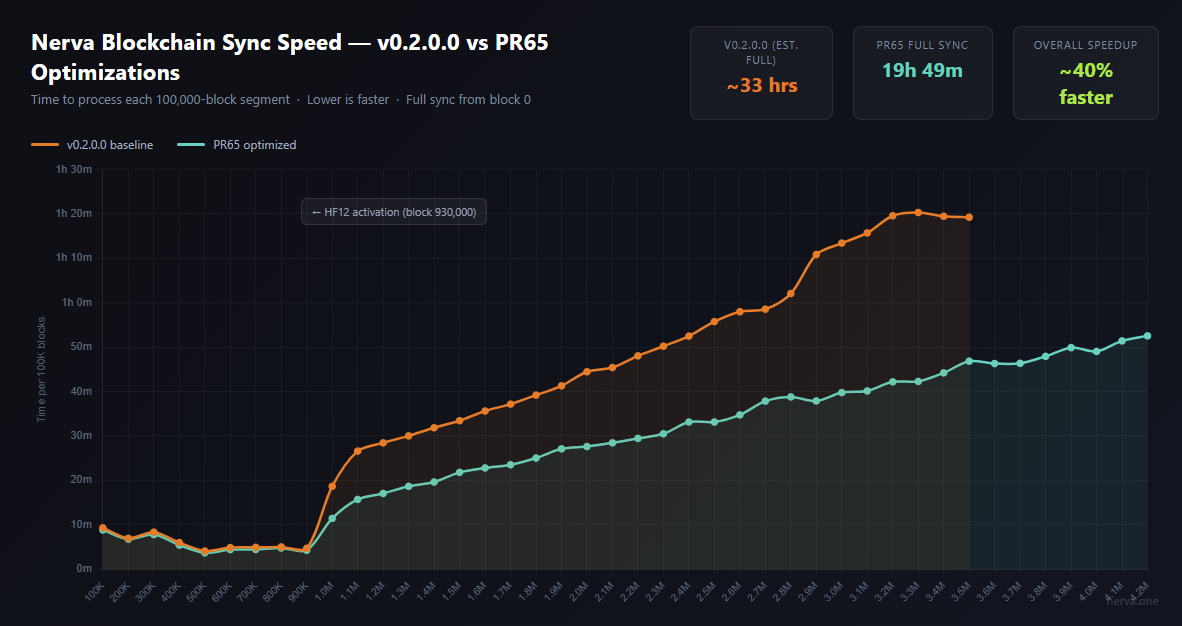
On an AMD Ryzen 9 7950X, PR65 synced the entire Nerva blockchain — over 4.2 million blocks — in 19 hours and 49 minutes.

The baseline v0.2.0.0 release was measured at 23 hours 9 minutes to reach block 3.5 million; extrapolating at the observed rate, a full baseline sync would take approximately 32–33 hours. That puts the overall improvement at roughly 40% faster, or about 1.67x the throughput.


Where the gains are biggest

The improvement isn’t uniform — it grows as the blockchain gets more recent:

Chain sectionImprovement
Blocks 0 – 1M (older chain)~6% faster
Blocks 1M – 2M~33% faster
Blocks 2M – 3M~37% faster
Blocks 3M+ (most recent)~40%+ faster

The part of the chain that used to take the longest is now the part that benefits the most.


What changed under the hood

The optimizations target two areas of the block verification pipeline that had become increasingly expensive as the chain grew past Hard Fork 12:

Redundant weight median recomputation. Block weight limits are calculated using a rolling median of recent block weights. The old code recomputed this median from scratch for blocks it didn’t need to — particularly during the initial block cache build and for blocks in the middle of large sync batches. These calculations now happen only when actually needed.

Smarter cache validation. When looking up historical block data, the old code re-validated cached entries using a full hash comparison even when a simple height check was sufficient. The new code skips the expensive hash lookup when the block height already confirms we have the right entry.

Neither change touches consensus rules — they are purely internal performance improvements with no effect on how blocks are validated or the chain itself.


These improvements will ship very soon, alongside wallet restore speed improvements and several other fixes, but this is only step 1. More significant sync speed improvements are coming in Hard Fork 13.
Nerva crypto just turned 8-years-old

Eight Years of Nerva: Still Here, Still Yours

On May 1, 2018, a cryptocurrency called Nerva launched with an unusual promise: no ASICs, no GPUs, no venture capital. Just CPU mining without pools, privacy, and a community. Eight years later — against considerable odds — that project is still alive. That is worth talking about.

Where It Started

Nerva was created with a clear vision: a truly decentralized, CPU-only privacy coin built on Cryptonight Adaptive — an algorithm designed to stay resistant to specialized mining hardware and mining pools. No ASIC farms, no GPU rigs — just ordinary computers run by ordinary people.

The early years brought real momentum. The algorithm attracted attention, the CPU-only mining philosophy resonated with people who believed decentralization actually mattered, and a community began to form around something that felt different.

The Years Nobody Talks About

What happened next is the part of Nerva’s history that deserves the most respect. After the founder left in 2021, the project did not die. A small group of community members stepped in, stabilized the network, maintained the software, and kept building — NervaOne, NerVault, core updates — largely without recognition and certainly without guarantees.

It was not glamorous work. It was the kind of work that keeps something alive when it would be easier to walk away.

In January 2026, Nerva was listed on NonKyc exchange, bringing renewed visibility and fresh energy into the project. The current outstanding supply stands at 19.16 million XNV, and the network continues to tick along — one block per minute, as it always has.

What Just Shipped

The birthday comes with two significant releases.

Nerva Core Software v0.2.1.0 dropped on April 23, 2026. This point release brings new CLI options for DNS and block tracking, mining thread visibility in daemon status, wallet stability improvements, multi-architecture Docker images for broader platform support, and Android compatibility for running the daemon on mobile.

NervaOne Wallet and Miner v1.0.0 was released a few days ago. You can now run a full Nerva node or wallet directly from your phone. The interface was rebuilt from the ground up to work consistently across desktop and mobile. Setting up a public node connection is faster and simpler. The address book got meaningful improvements. Sensitive wallet data now has a shorter memory lifetime during operations. And for impatient users, you can download the blockchain database directly — no more waiting through a full sync from genesis.

Eight years in, Nerva now fits in your pocket.

What Comes Next Is Up to You

Nerva is an open-source, community-driven project. There is no company behind it. There is no funded team. There are no employees. What gets built is built by people who care enough to show up.

That is either a weakness or a strength depending entirely on what the community decides to do with it.

If you mine Nerva, you are mining a CPU-only privacy coin the way it was meant to be — solo, no pools, just your processor against the network. If you run a node, you are part of the network’s backbone. If you write code, document something, translate content, post on social media, answer a question from a new user, or simply tell someone that Nerva exists — you are contributing to whether this project becomes something.

No single person can make Nerva succeed. A few developers and a handful of dedicated contributors cannot do it alone either. The projects that survive at eight years and thrive at ten are the ones where the community treats it as theirs — because it is.

Get Involved

  • Mine XNV — any CPU can participate. See the mining guides at nerva.one.
  • Run a node — NervaOne v1.0.0 makes it easier than ever, including on Android.
  • Contribute code — the repositories are open. Pull requests are welcome.
  • Build something new — create something that uses XNV.
  • Spread the word — write about it, post about it, tell someone.
  • Join the conversation — find the community on Discord, Telegram and socials.

Eight years is a long time for a small project to survive. Whether the next eight years are remarkable is not predetermined. It depends on the people who decide to be part of it.

Whether Nerva becomes something — that is up to you.

Happy birthday, Nerva.